Free scaffold quotations and site visits
Call 0203 9512168 today to get a free putlog scaffold quote.
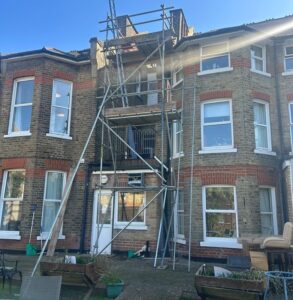
We provide a safe and efficient putlog scaffold installation service to customers throughout London. Putlog scaffolds are tied directly into the brickwork of a building using putlogs or tubes fitted with putlog adapters, and these are placed into a hole made in the masonry of the wall or positioned on top of progressive brickwork before the next course of bricks is laid.
This cost-effective and versatile solution is typically cheaper than traditional scaffolding because fewer components are used. Putlog scaffolding is widely used on construction projects for building and maintenance works, including:
Putlog scaffolding, also known as a bricklayers scaffold, is a single-scaffold system with only 1 set of outside standards (uprights) as the inside of the scaffold using the putlogs leverages the structural integrity of a building’s wall to support its working platform. This scaffolding method originates from old masonry techniques where logs were inserted into holes in walls.
Putlog scaffolds employ a single row of external standards. The putlogs function as connectors between the ledgers and the building’s wall, negating the requirement for inside standards (uprights). Putlog scaffolds require fewer components than independent scaffolds as they utilise the building’s wall for support, making them very stable, especially in adverse weather.
The main difference between putlog and independent scaffolding is their structure and support system.
Wall-supported: Relies on the walls of the building for support.
A single row of standards: Uses only one row of vertical supports on the outside of the scaffold.
Fewer components: Requires a reduced quantity of materials and components.
More stable: The building’s wall adds strength and stability, reducing wind and weather impact.
Free-standing: It does not utilise the building’s wall for structural support; instead, it relies on double bracing for stability.
Double row of standards: Uses two rows of vertical supports, 1 set of inside standards (legs) and 1 set of outside standards (legs).
More components: Requires a greater quantity of materials and components.
Less stable: Can be more vulnerable to wind and weather, especially for significantly taller scaffolds.
Although putlog scaffolding offers several advantages, it is not without its limitations:
Initial delay: Construction may be delayed as putlogs can only be inserted after brickwork sets.
Limited flexibility: Putlog scaffolding can be less flexible than independent scaffolds as It relies on the building’s wall for support, limiting its adaptability to different building shapes and sizes.
Skill requirement: Requires skilled and professional London scaffolding erectors for safe erection and dismantling.
A putlog scaffold is generally priced at a metre rate; our current rate for this type of scaffold is £15 – £45 per square metre; however, this is just a guide, and the price will increase significantly the higher the scaffold goes, and other variables will need to be taken into consideration.
Putlogs and transoms, both horizontal components, have similar functions and placements:
Putlogs: These tubes are horizontal members connecting the building’s wall to the ledger, forming the working platform. They are integrated into the wall with one end embedded into the brickwork or masonry of the building. A putlog tube is similar to a transom tube but has a spade/blade end or putlog adaptor on one end.
Transoms: These are horizontal tubes connecting both ledgers and standards to form the scaffold’s frame. The ledgers structurally support both ends of the transom tube, and the transoms provide structural support for the scaffold boards. A transom tube, typically 5ft or 6ft long, has the same diameter and thickness as a standard scaffold tube.
For heavy-duty tasks, the working platform should be raised to a height of approximately 1.35 to 1.5 meters. Putlog scaffolds can typically reach a maximum height of 15 meters, but taller putlog scaffolds may require the expertise of a structural engineer.
The maximum load capacity for general brickwork applications is 2.0 kN, while heavy-duty work provides a maximum load capacity of 2.5 kN.
To ensure workers’ safety and the building’s structural integrity, it is imperative to prioritise safety considerations when using a putlog scaffold:
Adherence to these safety measures can significantly mitigate risks and enhance worker safety on your construction site.
While less common, a putlog scaffold may be more suitable for your London brickwork project. Contact one of our estimators for more information and a detailed quote.